Portfolio Project Intelligence Layer
Self-updating operations dashboard that tracks local projects, Git activity, live deployment status, screenshots, stack signals, case-study readiness, and proof points — now with category filtering, GitHub links, and a stack breakdown chart.
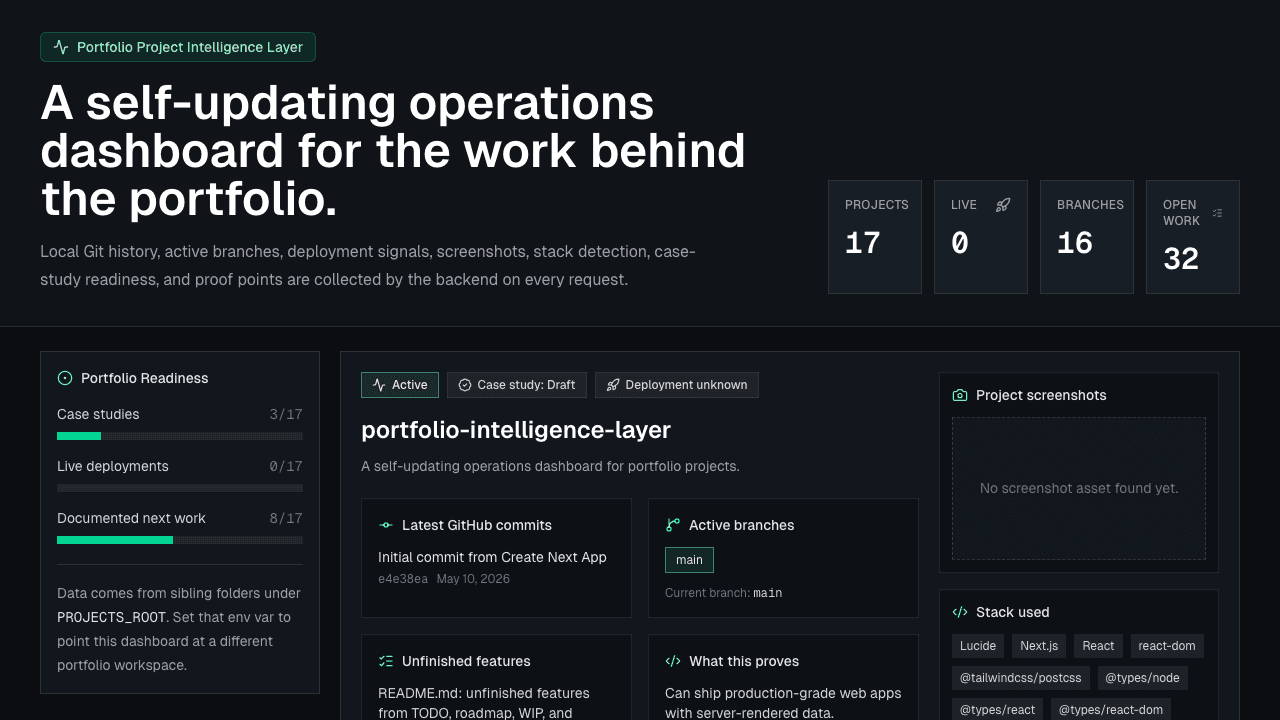
Overview
The Portfolio Project Intelligence Layer turns a static portfolio into a project operations dashboard. It scans a local workspace of project folders and builds a live snapshot of what each project is, how recently it changed, whether it is deployed, what stack it uses, and what it proves.
This is not a chatbot. It is backend infrastructure for keeping portfolio work honest, current, and easier to maintain.
Problem
Portfolio sites tend to drift out of date. Live projects move, GitHub activity changes, case studies lag behind implementation, and unfinished features get buried inside local repos.
The goal was to make project maintenance visible:
- Which projects are actually live?
- Which repos have active branches?
- Which projects still need case studies?
- Which features are unfinished?
- Which screenshots and stack signals already exist?
- What should each project communicate to a recruiter or collaborator?
Approach
Workspace Scanner
The backend scans sibling project folders from a configurable PROJECTS_ROOT. For each candidate project, it checks for Git history, package metadata, README content, screenshots, and deployment hints.
Git Intelligence
Each project record includes:
- latest commits
- active branches
- current branch
- last updated timestamp
- GitHub remote URL (handles both HTTPS and SSH remotes)
This makes the dashboard useful as an operations view, not just a gallery.
Deployment Detection
Checks for deployment URLs in project docs, local Vercel project links, and live links already published on arnavgokhale.com/projects.
That lets the system recognize that projects like Cortex, BAYC, GHRM, SelfRPG, LexiStack, Supply Chain Dashboard, and Euro Style Clusters are already live.
Portfolio Readiness Signals
The dashboard detects whether a project has a case study and pulls TODO, roadmap, WIP, and review notes from source files and documentation. This turns hidden maintenance work into visible next actions.
Category Intelligence & Filtering
Each project is classified into a category — Web, AI, Mobile, Data, Automation, or Tools — inferred from stack keywords at scan time. The dashboard UI exposes category and health filter pills so viewers can slice the 12-project list by type or status without page reloads.
Stack Breakdown Chart
The sidebar aggregates technology frequency across all projects and renders a ranked bar chart. Tallying Next.js, Python, GitHub Actions, TypeScript, and other labels across 12 repos makes the portfolio's actual technology distribution visible at a glance.
Tech Stack
- Next.js 16 with App Router (server + client components)
- TypeScript for structured project signals
- Node.js filesystem APIs for local workspace scanning
- Git CLI for commit, branch, and remote metadata
- Tailwind CSS for a dense operations-dashboard interface
- Lucide icons for compact controls and status indicators
Results
The dashboard tracks 12 portfolio projects and outputs a unified snapshot with live counts, branches, open work, deployment status, screenshot assets, stack tags, case-study status, and GitHub links. Category and health filters let viewers drill into specific project types instantly.
A JSON API at /api/projects exposes the same intelligence, making it possible to connect the data back into the public portfolio or other tools.
What This Proves
- I can turn a vague product idea into a working internal tool quickly.
- I can build backend data extraction around real developer workflows.
- I can design dashboards that surface operational state instead of just presenting content.
- I can connect local development, Git history, deployment metadata, and portfolio storytelling into one system.
- I can ship iterative improvements to production tools with full spec/quality review cycles.